Gishwati-Mukura National Park is the newest national park in Rwanda located in the Western province along the Congo-Nile Divide, a line of hills that separates the river flowing into the Congo Basin from those flowing into the Nile Basin in Rutsiro and Ngororero district. The park lies between Lake Kivu and Nyungwe Forest National Park. before the area was covered by a large stretch of thick rainforest that connected the Gishwati and Mukura forests. However, during the 1980s and 1990s forest was destroyed due to human activities like cattle grazing, farming and settlement. After 1994 Rwanda genocide more people settled in the area which led to continuous deforestation.
By the early 2000s a small part of the original forest remained and to save what was left, conservation Organizations like Forest Hope Association, Rwanda government and other partners started forest restoration projects. They planted trees, protected water resources and worked hand in hand with local communities in order to spot illegal activities. The forest recovered slowly and attracted wildlife. In 2015, the government officially established Gishwati-Mukura National Park by combining the two forest reserves. Later in 2020, the park was designated as a UNESCO’s World Biosphere Reserve. The protected area covers an area of 34 square kilometers and includes two forest sections namely Gishwati in the north and Mukura in south.
Flora and Fauna in Gishwati–Mukura National Park
Gishwati-Mukura National Park is covered by the montane forest with mixed vegetation featuring bamboo, grassland and swamp forest. The forest hosts a variety of tree species for instance; Macaranga kilimandscharica, Polyscias fulva, Prunus africana, Hagenia abyssinica, Harungana montana, Symphonia globulifera, Dracaena afromontana and Cyathea manniana, a giant tree fern. The vegetation in Mukura section is still recovering from threats associated with human activities which include illegal mining, deforestation for settlements, animal grazing and agricultural land. However there is a project going on focusing on conservation and reforestation. As they are planning to plant trees in the manipulation zone of the national park where human activities like forestry, settlements and cropping are taking place.
Gishwati-Mukura National Park also hosts a wide range of fauna which include five primate species. These include the golden monkey, chimpanzee, black and white colobus, L’Hoest monkey and blue monkey. Other mammals present in the park include African golden cat, serval cat, black fronted duiker, red river hog, southern tree hyrax among others. The park also hosts over 232 bird species including Albertine rift endemics. Some of these birds include; white-headed wood hoopoe, Rwenzori turacos, mountain yellow warbler, Rwenzori batis, dusky crimson wing, martial eagle, purple breasted sunbird, regal sunbird, and strange weavers.
Activities in Gishwati-Mukura National Park
Gishwati-Mukura National park has a variety of activities which include; bird watching, nature walk, cycling, and primate watching.
Primate watching
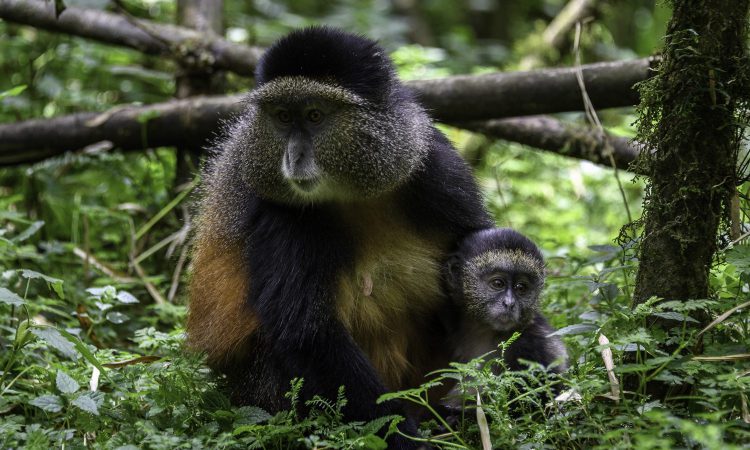
The park is a home to several primate species and the most famous primate in the park are chimpanzees. They live in small groups within the Gishwati forest area. Visitors going for primate watching are led by park rangers and trackers to search for them. You may even hear the chimps calling from deep in the forest or see them moving through trees, playing or feeding. Apart from chimpanzees, the park also hosts L’Hoest monkeys, blue monkeys, and golden monkeys.
Cycling in Gishwati-Mukura National Park
Cycling is one of the eco-friendly activities you can do around Gishwati-Mukura National Park. It takes you around the rolling hills of Rwanda. Cycling is done along the Congo-Nile trail which runs from Gisenyi in the north and Rusizi in the south following the shorelines of Lake Kivu then Nyungwe Forest. The activity offers visitors an opportunity to ride through tea plantations, forested hills, and small villages. Visitors participating in cycling are recommended to have helmets, water, sun protection and comfortable clothing. The cycling tours are led by the guides and bikes are arranged by the tour operators or lodge.
Nature walk in Gishwati-Mukura National Park
The activity offers a chance to visitors to explore the inner parts of the forest. During a guided nature walk, the park rangers share information about different tree species, birds and animal tracks along the trail. The park has over 60 tree species which include ferns, orchids, bamboo, mahogany, and Macaranga kilimand. The park conservationists have introduced new species like hagenia abyssinica, polyscias fulva, eucalyptus, macaranga, and dombeya torrida. You may also spot chimpanzees, golden monkeys and blue monkeys. The trail is long and difficult so visitors can choose between short or long hikes. Along the way you may pass through Kazeneza waterfall in the middle of the park.
How to access Gishwati-Mukura National Park
The park can be accessed by road from several parts of Rwanda. Gishswat- Mukura National Park is located between Rubavu and Karogi along the Congo Nile Divide. From Kigali, the drive takes about 4 to 5 hours taking you through Muhanga and Ngororero. From Rubavu, the drive takes around 2 hours offering views of Lake Kivy and the surrounding hills. From Karogi, the journey takes about 2 and half hours to the park taking you through local communities. The park can also be accessed from Uganda. For instance from Mgahinga or Bwindi Impenetrable National Park as you can combine gorilla trekking with activities in Gishwati-Mukura National Park. Visitors are advised to use a 4×4 safari vehicle since the park is hilly and slippery.